
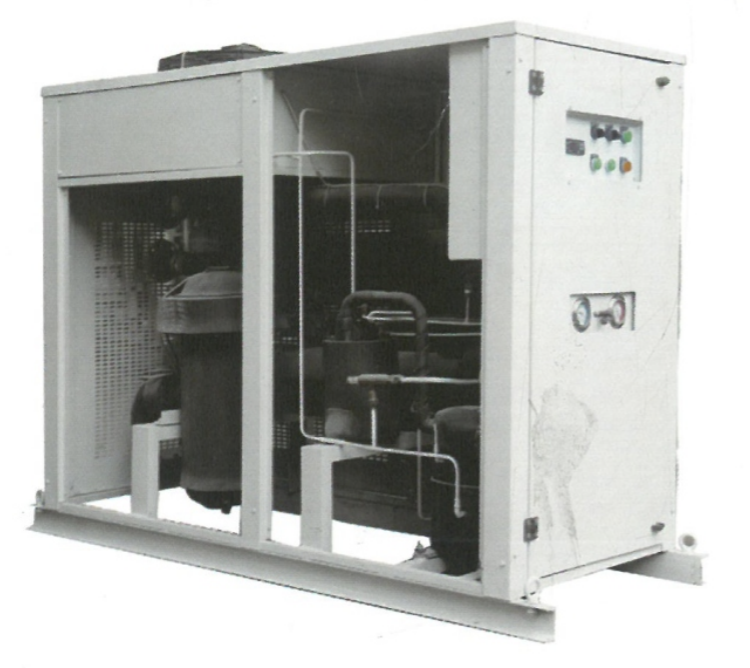
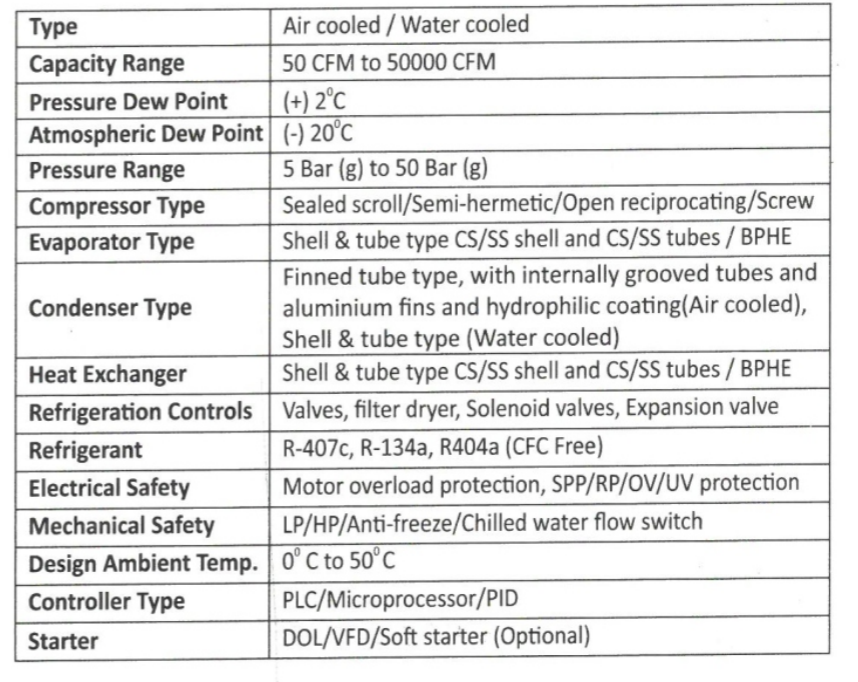
Glycol Based Air Dryer
A Glycol Based Air Dryer is an advanced compressed air drying system designed to remove moisture from compressed air using a glycol-based refrigeration medium. It ensures a continuous supply of clean, dry, and moisture-free air, which is essential for protecting pneumatic equipment, improving process efficiency, and maintaining product quality in industrial applications.
This system works by cooling compressed air using a glycol solution as the secondary refrigerant. The glycol absorbs heat efficiently and helps achieve stable low dew point temperatures, making it highly effective for industries that require consistent and reliable air drying performance.
At HiTech Sales & Service, we manufacture and supply high-quality Glycol Based Air Dryers engineered for energy efficiency, durability, and long-term industrial use. Our systems are designed to deliver stable performance even under varying load and environmental conditions.
Features
Efficient Moisture Removal from Compressed Air
Stable Low Dew Point Performance
Glycol-Based Heat Exchange System
Energy-Efficient Operation
Reliable Continuous Air Drying
Corrosion-Resistant Construction
Low Maintenance Requirements
Compact and Industrial-Grade Design
Suitable for Heavy-Duty Applications
Working Principle
A Glycol Based Air Dryer operates on the principle of indirect cooling using a glycol solution as the heat transfer medium. The system typically includes an evaporator, glycol circulation system, heat exchanger, compressor, condenser, and expansion device.
1. Glycol Cooling Process
The glycol solution is cooled inside a refrigeration system. This chilled glycol acts as a secondary refrigerant and is circulated through the system to absorb heat from compressed air.
2. Compressed Air Entry
Hot and moisture-laden compressed air enters the air dryer and passes through a heat exchanger where it comes into contact with the cooled glycol circuit (indirectly).
3. Moisture Condensation
As the compressed air temperature drops, water vapor present in the air condenses into liquid form. This moisture is then separated and drained out through an automatic drain system.
4. Refrigeration Cycle
The refrigerant in the system absorbs heat from the glycol solution in the evaporator, causing the refrigerant to evaporate into a low-pressure vapor.
5. Compression and Heat Rejection
The refrigerant vapor is compressed by the compressor and then sent to the condenser, where heat is rejected to the surrounding air or cooling water. The refrigerant then condenses back into a liquid state.
6. Expansion and Recirculation
The refrigerant passes through an expansion device, reducing its pressure and temperature before returning to the evaporator to continue the cooling cycle.
7. Continuous Drying Cycle
The glycol remains continuously chilled and circulated, ensuring that incoming compressed air is consistently cooled, and moisture is effectively removed throughout operation.
Advantages
High Efficiency Moisture Removal
Stable Dew Point Control
Protects Pneumatic Equipment from Corrosion
Improves Product Quality in Sensitive Processes
Energy-Efficient Operation
Reliable Performance in Continuous Use
Reduced Maintenance Requirements
Suitable for Industrial-Scale Applications
Applications
Pharmaceutical Industries
Food and Beverage Processing
Chemical Manufacturing Plants
Textile Industries
Packaging Industries
Automotive Workshops and Paint Shops
CNC and Pneumatic Machinery Systems
Electronics Manufacturing Units
General Industrial Compressed Air Systems
Why Choose HiTech Sales & Service?
HiTech Sales & Service provides advanced Glycol Based Air Dryer solutions designed for consistent performance and long-term reliability. Our systems are engineered with precision to ensure effective moisture removal, energy efficiency, and protection of critical pneumatic systems.
We offer complete services including design, manufacturing, installation, commissioning, and maintenance support to ensure uninterrupted and efficient operation of your compressed air systems.